Showing posts with label crochet. Show all posts

Thursday, January 19, 2012

Bean's Blanket


My sister-in-law is pregnant with her first child, a boy (currently nicknamed "Bean"), so I decided to crochet a baby blanket for him. I chose a wide variety of bright colors, and though I used a rainbow sequence, you'll see that I didn't rigidly stick to a color pattern.
The crochet pattern is very easy, and works well for a baby blanket because it doesn't have lots of gaps for teeny weeny baby toes to get caught in.


Crochet Pattern for Bean's Baby Blanket:

Chain an uneven number
Row1: Work 1 SC (single chain) in 2nd ch from hook and in each ch to end. Ch1, turn.
Row 2: Working through the front loop only, work 1 SC in 1st and each ch to end. Ch1, turn.
Repeat row 2 for pattern.

I used a combination of synthetic yarns and crochet cotton. Because of the different thicknesses of the yarns, I had to be careful to use the thin cottons in a sequence (every 4th row), to avoid the finished product being unevenly weighted.

Above: Every 4th row is cotton, to keep the weight as even as possible. Not all of the synthetic yarn is the same thickness, though. Note how thick the dirty pink is (left of the middle of the photo), compared to the orange next to it. Altogether, the texture is very interesting.

Above: By turning the blanket over after completing each row, there is no '"front" or "back" on the blanket. 

To finish, I used the same stitch to make a border of 6 rows. I debated putting tassles onto the blanket but decided to leave these off, because I didn't want Bean's little nose to be tickled by them. I'm hoping that this will become a real drag-around kind of blanket.

Hope you enjoy your blankie, Bean!

Friday, October 7, 2011

Peruvian Alpaca Clothing

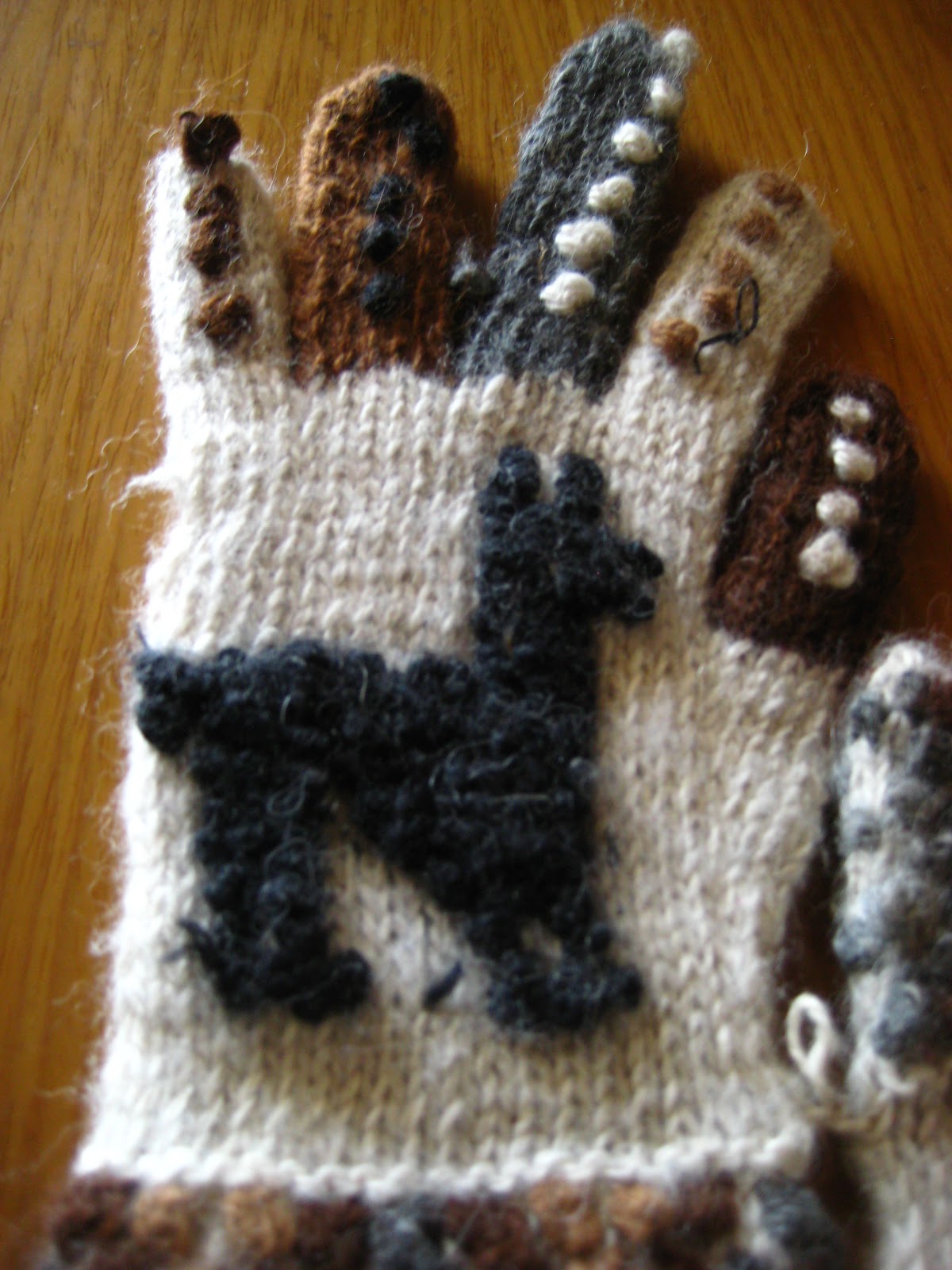
I love coming across hand made products from other countries. These belong to some friends of mine, who recently visited Peru. The fiber hasn't been dyed, so the colors are the natural colors of the animal fiber. These beanies and gloves have been hand-knitted on cactus needles.

Above: Skilled crafters have created textures and interest by adding "popcorn" to the knit pattern. 


Above: The fun alpaca designs that have been worked into these gloves will appeal to children and adults alike. There are hundreds of natural shades of alpaca fiber, and when used together, as above, these natural tones are vibrant and appealing.

Above: Alpaca fiber is warmer than sheep's wool, and depending on the quality, can be softer than any other natural fiber. 

I've been planning for years to take up knitting, so I don't know too much about the craft, however, I think the "popcorn" effect may have been created with a crochet hook, after the completion of the knitted item.


Tuesday, October 4, 2011

Work in Progress: Raad Baby Blanket

Reading copious amounts of Terry Pratchett has given me a soft spot for puns. This particular pun is a play on my friend's surname, Raad, and the slang term, "rad". She's pregnant, and the crochet blanket will be a gift to her child, becoming a Raad blanket. Get it? Get it? Oh, man, I crack myself up.

Above: The Raad blanket uses the classic granny square crochet design.

Above: Each square has a silver border, so that I can hide the join easily by using silver crochet yarn when attaching them.

Above: I chose to use opposite arrangements of light and dark colors. This creates both balance and interest in the design.

 Above: The crochet baby blanket is crafted using bamboo yarn (yup, you guessed it, from my favorite yarn maker - Vinni's). The bamboo crochet yarn is incredibly soft, has a nice weight and a lovely sheen. A color that would have been grey in any other yarn, becomes silver, because of the sheen of the bamboo yarn. I think it's going to turn out beautifully.

I'm using a no.4 crochet hook, with a double stitch. For each row, I turn the piece over, so that there is no "front" and "back" to the square. On the third, fourth and fifth rows (counted from the center), I crochet into the top of the stich, instead of the big gap between the stiches. This gives the blanket even more fluidity of movement. 
A word of advice for crocheting with bamboo yarn; take it slow and hide your cut ends. Mistakes wrought in this yarn are highly visible and it can be frustrating to go over each square looking for shaggy ends and missed threads.


Wednesday, September 28, 2011

Future Skill: Fiber Carding

Some of my favorite people breed Alpacas, a smaller cousin of the better-known camelid; the Llama. They are about to start shearing the animals, and I'm planning to spend a week or two with them, cleaning, sorting and processing the fiber. It's an opportunity to learn some new skills, and I'm hoping to take up some parts of the process, such as carding and spinning, as a hobby. The first part of the process that I'm interested in is carding.

Above: This is a mechanical carding machine, known as a drum carder. It can be used to process hair, wool, or vegetable fibers such as cotton.

The drum carder straightens the fibers and aligns them so that the fiber can be spun more easily. During the carding process, different colors of hair, wool or cotton can be combined to created a variegated color scheme. Once spun, the multi-colored yarn can be knitted, crocheted or woven to create a marbled effect.

Above: On the left of the picture you can see the hand-crank mechanism of the drum carder. In the background is carded fiber, ready for spinning. 

Above: It seems that although there are a number of tools that can be used with a carder, this paddle brush is the most useful, and can either be used to encourage the fiber to lie straight, or to remove leftover fiber from the drum.

Above: Hand-powered machines fascinate me. My generation is accustomed to plugging everything in, which has made us complacent. We aren't aware of how much energy we would use to complete even simple tasks. It's refreshing, and reassuring, to know that man-powered mechanisms are still being produced and used.

Fiber processing puts me in mind of a time when women used to sit together doing women's work. It was laborious, time-consuming work, but I believe the result was very satisfying for these women. It was a time in which the product of their labor was visual proof of human effort; the difference between each woman's workmanship a signature, that mom, or aunty or grandma (or all of them) had crafted that item, just for you, from scratch.
I'm really looking forward to learning this, and other, fiber processing skills.


Thursday, September 22, 2011

Work in Progress: Crochet Flower Skirt

For years I have been crocheting with synthetic yarns. Whenever I walked into my local haberdashery, I wouldn't even look at the natural yarns section. My heart couldn't take it, knowing that all of those scrumdiddlyumptuous cotton, bamboo, alpaca and pure wool yarns were there, within my reach but outside of my price range.

Then one fateful day, not so long ago, something extraordinary happened. My boyfriend and I went to the habby shop, where we found ourselves standing next to a shelf of delicious-looking natural yarns. He reached out his hand, picked up a ball of Vinni's Cotton, gave it a squeeze and said, "This is nice. Would you like some?"

Well, I couldn't very well say no to such a sweet offer like that, so he bought me one ball of every color on the shelf. Hubby did good. :)

I love the Vinni's range. They cost pretty much the same per gram as synthetic yarns, but the quality of the natural yarns is exceptional. I'm busy with the Nikkim range, which is hand-dyed here in South Africa as part of a poverty relief program. Not only are these yarns a pleasure to work with, it's nice to know that buying these products helps others in need.


Above: Vinni's Nikkim range is hand-dyed with three similar colors. The resulting effect is lovely.

As you can probably tell from the pictures, the crochet skirt is designed to be worn over another skirt or a pair of little shorts. Now that I have a sewing machine, I might even make a slip to wear under it. With all these new ideas for improving the skirt, hopefully I'll finish it before summer arrives!

Sunday, September 11, 2011

"Autumn Morning" Crochet Scarf

A friend of mine just turned 25 (for the 6th year in a row). I don't usually make a big deal of my friends' birthdays, but once in a while I like to do something nice. So, for his birthday this year, I decided to make him one of his favorite fashion accessories - a scarf.

Above: I chose autumn colors because he mostly wears orange, green or blue clothing. The brown has a slight magenta hue to it, complimenting the cooler colors beautifully. I used a bamboo yarn (details below), which has a lovely shimmer to it. It's very soft and smooth, making it a bit tricky to work with, but the finished result has a lot of flexibility and a comforting weight to it. 

Above: The pattern uses stitches that cross over each other, creating extra texture in the crochet. Although I like to use a variety of colors in my crochet projects, I think this stitch might look best if crafted in one color.

Crochet Pattern for "Autumn Morning" Crochet Scarf

Chain a multiple of 6 plus 5

Row 1: Crochet 1 sc (single chain) in 2nd chain from hook and in each chain to the end. Chain 1 and turn.
Row 2: Crochet 1 sc in the first sc, *skip 1 sc, 1 dc in next sc, 1 dcin skipped sc, 1 sc in each of next two sc. Repeat from * to end, ending with 1sc in last sc. Chain 2 and turn.
Row 3: Skip first sc, 1 sc in each of the next 2 dc, *skip 1 sc, 1 dc in the next sc, 1 dc in skipped sc, 1 sc in each of next 2 dc; rep from *, ending 1 dc in last sc. Chain 1 and turn.
Row 4: 1 sc in first dc, skip next sc, 1 dc in next sc, 1 dc in skipped sc, *1 sc in each of the next 2 dc, skip 1 sc, 1 dc in next sc, 1 dc in skipped sc; repeat from * to end, ending with 1 sc in the top of the turning chain. Chain 2 and turn.

Repeat rows 3 and 4 to create the pattern.

Above: The finished crochet scarf. I added tassles (knotting the ends to prevent tangles) as a contrast to the crochet pattern. 

I used Vinni's cottons' 100% bamboo yarn (Serina), and a 5.5 crochet hook. I used a size 7 crochet hook for the starting chain to prevent that edge being tighter than the body of the scarf. (See more on this method here)
I wouldn't recommend such a smooth, soft yarn for a beginner crochet project, as it can be a bit tricky at times. A similar result can be crafted with cotton yarn, which has more 'grip' and is easier to work with.

Interested in the craft of crochet? Check out Guerrilla Yarn Artists combine Graffiti and Craft for inspiration


This Blog Parties!
BWS tips buttonThe DIY Show OffThe Shabby NestThirty Hand Made Days
freckled laundryIt's a Blog Party

Sunday, September 4, 2011

Saturday, September 3, 2011

Sunset Shell Blanket

My sister has just moved in with some friends of ours, and as a house-warming gift, I crafted a crochet blanket for her. There's something ironic a bout this blanket - the colors. I had a lot of wool left over from another crochet blanket (The Red Rambler - I'll post on it soon), and it turns out that the colors were exactly what she was looking for. Lucky lucky!

Colors: moonstone, beige, orange, red, purple, brown

Crochet Pattern for Sunset Shell Blanket:


Chain a multiple of 3.

Row 1: Crochet 3 half-doubles in 3rd ch from hook (shell). *Skip 2 ch, 3 half-doubles in 3rd ch. Continue from * to the end of the row. To finish the row, crochet one half-double in the last ch. Ch2 and turn.
Row 2: Skip 1 stitch, 3 half-doubles in the 2nd stitch. *Skip 2 stitches, 3 half-doubles in 3rd stitch. Continue from * to the end of the row. To finish the row, crochet one half-double in the last stitch. Chain 2 and turn.

Repeat row 2 to create the pattern.


I crocheted two rows of each color to accentuate the pattern. I think I'll try three on a future project. This pattern was so much fun to work with that I will definitely be using it again.

For the edging, I used a pattern of; *half-double, ch1, skip a stitch, repeat from*. It creates a very loose and stretchy edging, ideal for a curl-up-on-the-couch blanket.

Solving the "tight edge" problem in crochet: Using the same size hook for the chain edge and body leads to the chain edge being tighter than the body, creating less "give" at that edge. Use a hook for the edge that is 1mm or 1.5mm bigger than the hook that you used for the body. For example; I used a 7mm hook for the edge and a 5.5mm edge for the body of the blanket.

I can't wait to give her the blanket. Spring is officially here, but I think there will still be plenty of cool nights for her to use the blanket on.

Buy Crochet Products Online:
Before you start crafting your next crochet project, 
consider adding these items to your crochet collection.

Share your Quilting Links at my Quilting Link Party


This Blog Parties!
Keeping It SimpleThe Southern Institute
Related Posts Plugin for WordPress, Blogger...